Castle South Uranium Project
Uranium Exploration in the South Western Athabasca Basin, Saskatchewan
The Castle South Uranium Project is a large-scale uranium exploration property located along the southern margin of the Athabasca Basin in Saskatchewan, Canada.
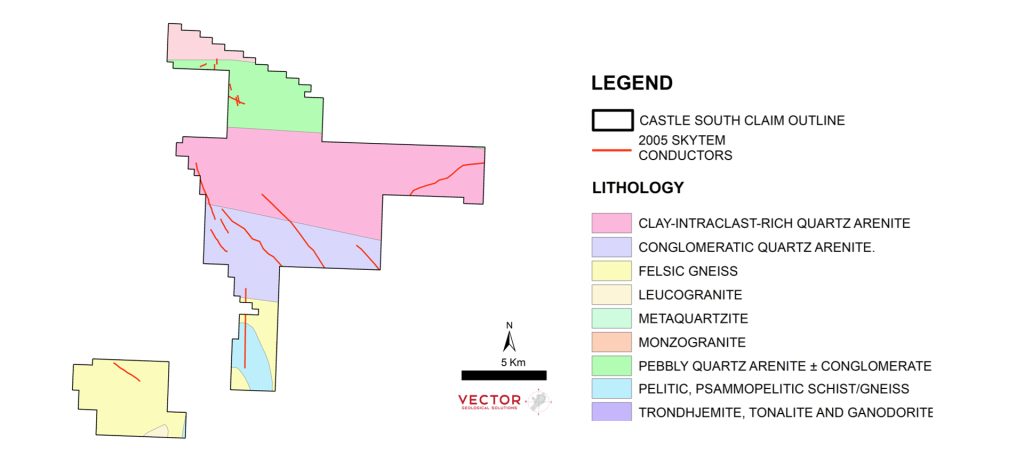
The project covers approximately 28,688.43 hectares and occupies a geological setting characterised by major structural features, extensive electromagnetic conductors and multiple high-priority geophysical targets.
Canadian Uranium Corp. has the right to earn an 80% interest in Castle South. The Company also considers the project a potential joint venture candidate and a geological analogue to the Rook One area.
Project Highlight
- Approximately 28,688.43 hectares
- Located along the southern margin of the Athabasca Basin
- Canadian Uranium can earn an 80% interest
- Potential joint venture candidate
- Considered by the Company as a geological analogue to the Rook One area
- At least five high-priority exploration target areas
- Approximately 52 kilometres of electromagnetic conductors
- High-conductivity geophysical anomalies
- Magnetic highs associated with listric and dyke structures
- Significant large-scale fault systems
- Historical airborne geophysical survey completed in 2007
Geological Setting
Castle South occupies a strategic position along the southern margin of the Athabasca Basin, where the property straddles the basin lip and hosts several significant large-scale fault structures.
The project area contains structural corridors, conductive trends, magnetic anomalies and fault systems that form important components of uranium exploration models in the Athabasca Basin.
The presence of extensive electromagnetic conductors and magnetic highs associated with listric and dyke structures provides multiple geological environments for evaluating structurally controlled uranium mineralisation.
Historical Exploration
Historical geophysical exploration has identified multiple prospective areas across the Castle South Uranium Project. An airborne geophysical survey completed in 2007 identified at least five high-priority target areas, including magnetic highs, highly conductive anomalies and extensive electromagnetic conductor trends.
Approximately 52 kilometres of EM conductors have been identified across the property, providing a substantial historical dataset for further interpretation and target refinement.
These historical exploration results provide a foundation for integrating modern geophysical methods and updated geological models across the project.
Exploration Opportunity
Castle South provides Canadian Uranium with a substantial uranium exploration position along the margin of the Athabasca Basin. The combination of major structural features, extensive EM conductors, magnetic anomalies and multiple high-priority geophysical targets creates a strong foundation for systematic exploration.
Future work can focus on re-evaluating historical geophysical data using modern geological interpretation to refine priority areas for additional fieldwork, geophysical surveying and potential drilling.
Canadian Uranium’s objective is to advance the geological understanding of Castle South and evaluate its potential to host structurally controlled and basement-associated uranium mineralisation.
Gallery
Coming soon!